Any business to be run successfully must be run with more than just hard work; it must be run with clarity, coordination, and control. With increasing companies, large volumes of financial, sales, operations, and human resource data are stored. In the absence of a centralized system, such information is scattered, and thus it would be difficult to make informed decisions or to do business effectively. Enterprise resource planning (ERP) is needed at this point.
Enterprise resource planning (ERP) refers to an elaborate software system that is used to organize and integrate the major business functions of an organization. These functions are finance, human resources, manufacturing, supply chain, procurement, and sales. ERP consolidates all these processes in a single system, where they provide the correct real-time information. Such a centralized visibility enables companies to simplify business, enhance cooperation, and make more intelligent decisions.
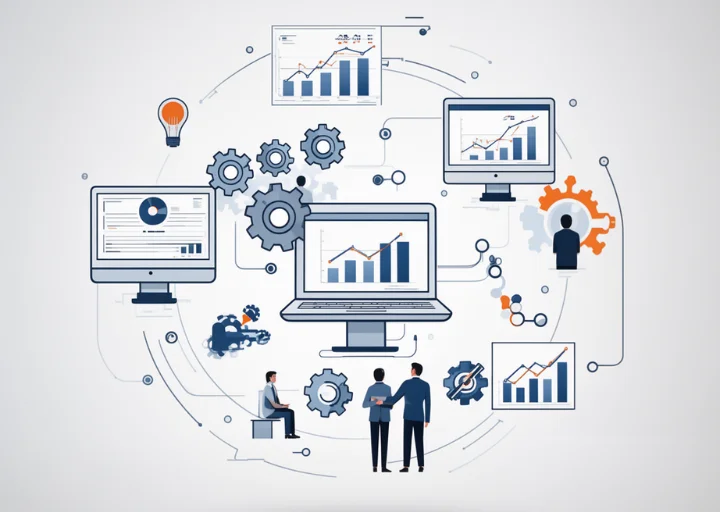
Introduction to Enterprise Resource Planning
In order to learn about ERP, think of a business as a living organism. Every department-finance, sales, logistics, and HR-is a vital organ, just like organs in a body. Although the functions are independent of one another, they are interdependent. Late inventory will impact sales, financial mistakes can trigger procurement or payroll.
ERP software is the focal point of communication that links these functions. ERP provides departments with an ecosystem where individual departments no longer operate independently. This integration will make sure that the flow of information within the company is smooth and coordination is more efficient among the teams. The outcome will be increased efficiency, fewer mistakes, and a better understanding of the business performance.
The history and evolution of ERP
ERP systems have been greatly developed over the last 100 years. The initial business management systems were completely manualized, with paper records being used in production planning and scheduling. These were tedious, labour-consuming, and subject to mistakes.
The developers started to use computer-based applications in the 1960s to enhance efficiency among manufacturers. These initial systems automated a few tasks, like inventory tracking or production scheduling, but they were not integrated and acted separately. With the rise in technology, software programs such as the material requirements planning (MRP) came into existence and assisted the manufacturers in controlling production materials.
By the 1990s, the ERP systems had gone out of manufacturing and became indispensable tools used by organizations across all industries. As the speed of internet connection increased and new development tools were introduced, ERP systems became stronger and became accessible.
The modern ERP platforms include the latest technologies, including artificial intelligence and machine learning, natural language processing, and real-time data processing. These innovations can help organizations automate operations, acquire actionable insights, and respond to the dynamism of business.
Why is enterprise resource planning important?
The ERPs are very important in the smooth running of businesses. The provision of a centralized database that serves as a single source of truth to the whole organization is one of their most important roles.
ERP is used differently in various departments:
- ERP enables finance teams to handle accounting and costs and to close financial periods with accuracy.
- With the help of ERP, sales teams can monitor customer orders, track revenue, and manage relationships.
- ERP is used by logistics to organize the shipping process, inventory, and fulfilment process.
- ERP helps the procurement teams in the management of suppliers, purchase order and relations with vendors.
- ERP is used by accounts payable teams in order to make timely, correct payments.
- ERP is used by executives and managers to examine performance and provide direction to strategic planning.
ERP-generated reports enable transparency and accountability to investors and financial institutions.
In the absence of the ERP, an organization would be exposed to potential inconsistency and outdated information that may result in an inability to make good decisions and inefficiencies in operations.
ERP Examples by Industry
ERP systems offer value in almost all industries, but their usage differs according to the needs of the business.
Manufacturers
ERP is an ERP tool that is used by manufacturing companies to control manufacturing schedules, inventory levels, and product quality. ERP assists manufacturers in tracking the performance of equipment, managing expenses, and ensuring that resources are used efficiently. It also gives an overview of the supply chain, resulting in improved demand planning and inventory management.
Travel
Etelligens builds travel ERP software solutions that bring these moving parts into one system, so teams can automate operations, reduce manual errors, and gain real-time control across sales, reservations, finance, and reporting. From tour operators and travel agencies to DMCs and online travel platforms, our ERP examples include modules like booking management, supplier contracts, itinerary planning, commission tracking, invoicing, accounting, and analytics dashboards-designed to scale as your business grows.
Retailers
The retail companies use ERP to deal with both online and physical shops. ERP incorporates inventory management, customer orders, and shipping. Through this integration, retailers are able to achieve accurate product availability, enhance customer experiences, and optimize pricing and promotions.
Service-centric companies
ERP is also used by professional service firms, including an accounting firm, engineering firm, and consulting organization, to manage the project, billable hours, and profitability. With ERP, these companies are able to manage resources effectively, overcome deadlines, and maintain financial stability.
Utilities
ERP assists utility providers in maintaining infrastructure, maintaining a schedule of maintenance, and making capital investments. ERP can also assist in making sure that there are enough spare parts and equipment at the right time, avoiding any disruption of the services and minimizing operational expenses.
Wholesalers
Wholesalers use ERP to deal with inventory and logistics and simplify order processing. ERP assists in enhancing order fulfilment, cutting operations costs, and speeding payment cycles, which reinforces cash flow and profitability.
How do ERP Systems Work?
ERP systems have several integrated modules, which are used to handle a particular business operation. These modules can be finance, human resources, supply chain management, procurement, and customer relationship management.
Each of the modules has a common database, which enables information to flow freely across departments. An example of this is when entering a sales order, the system automatically changes inventory, financial records, and shipping schedules.
Other software solutions that can be integrated with the ERP software include the e-commerce software, customer relationship management software, and payroll software. These integrations enable the total picture of business processes and enhance the team-to-team coordination.
The current ERP systems are dynamic, and an organization can have flexibility and can add modules or increase functionality as the requirements of the organization change.
Types of ERP Deployment
Depending on the needs, financial capacity, and technical abilities, businesses have a number of options for ERP deployment models.
Cloud ERP
Cloud ERP is stored on a remote server and can be accessed via the internet. This model removes hardware requirements on the ground and decreases IT maintenance requirements. Cloud ERP is also easy to scale and update automatically and can be accessed remotely, thus being an effective choice for organizations in the current era.
On-premises ERP
On-premise ERP is deployed on the company-owned servers and is managed by the company. This method offers increased data and system configuration control. It, however, needs a lot of investment in hardware, maintenance, and IT skills.
Two-tier ERP
Two-tier ERP involves the integration of different ERP systems in different sections of an organization. To illustrate, a parent organization can have an on-premise ERP system, whereas subsidiaries can have a cloud-based system. The method is flexible and is conducive to a slow transition to newer systems.
Hybrid ERP
Hybrid ERP is a combination of on-premise and cloud. Organizations are able to store sensitive information on a local server and scale and access it via the cloud-based solutions. This will be flexible and still secure and compliant.
Six Key Benefits of ERP
ERP programs come with many benefits that enhance optimality, transparency, and business performance.
Higher productivity
ERP eliminates repetition and rationalizes processes, enabling employees to concentrate on operational activities rather than manual processes.
Deeper insights
ERP helps in planning business by consolidating the information into a single system, which eradicates information silos and enables effective information about business performance.
Accelerated reporting
ERP makes reporting easier by creating real-time operational and financial reports, thus facilitating a quicker decision-making process.
Lower risk
ERP will enhance compliance and data accuracy and decrease the possibility of error or financial differences.
Simpler IT management
The integrated systems also make the IT operations more efficient by simplifying the complexity of managing various software tools.
Improved agility
ERP helps organizations to react promptly to market changes and exploit new opportunities through real-time information.
How do I know if I’m ready for an ERP system?
Many businesses start with basic tools like spreadsheets or standalone software. However, as operations grow, these tools often become inefficient.
Common signs that a company needs ERP include:
- Excessive time in the day-to-day activities.
When the timeline for completing simple duties like the closing of financial records is more than the volume of time it ought to be, the problem can be the utilization of excessive, fragmented systems. Using individual tools will slow down the workflows and bring inefficiencies.
- Problems with access to important business data.
Do you have the capability of locating important business details, like product-based revenue or the quantity of returned goods, in a short period of time? Otherwise, the lack of connected systems and access to performance metrics and KPIs can compromise your visibility. Decision-making is more cumbersome and time-consuming in the case of a lack of centralized data.
- Runaway business processes
Do you find some of your operations hard to manage? You might be struggling to cope with inventory, customer expectations, or cost efficiency. With the growth of organizations, processes tend to get more complicated and difficult to monitor.
- Absence of standardization and redundant data sets.
Duplicate data entry and inconsistent information are soon to be significant problems if departments are operating on different systems and workflows to accomplish their duties. Failure to use systems that communicate effectively means that reporting takes a long time and the likelihood of errors is high.
- Too many foregone things.
Teams are so stressed with the day-to-day operations that they do not have time and wisdom to seek new growth or innovations. The visibility of business performance is limited, and thus, it is difficult to see areas that are profitable in terms of expansion.
ERP addresses these challenges by integrating systems and providing better control over business operations.
10 Things to look for in an ERP System
When selecting ERP software, organizations should evaluate key features to ensure long-term success:
- A unified database: Centralized data and a single reliable source of truth for consistent shared information and a complete cross-departmental view of the organization
- Built-in analytics: Integrated analytics, self-service business intelligence, reporting, and compliance features that provide meaningful insights throughout the entire organization
- Data visualization: Graphical display of critical information using dashboards, KPIs, and interactive analytics tools to support faster and more informed business decisions
- Automation: The ability to streamline repetitive activities using advanced robotic process automation (RPA) enhanced by artificial intelligence and machine learning technologies
- Consistent UI/UX: A uniform interface and experience across modules, with simple configuration and customization tools for workflows and users-including customers and vendors
- Integration: Seamless connection of business operations and workflows along with open compatibility with external third-party applications and multiple data sources
- Advanced technologies: Support for generative artificial intelligence and machine learning, virtual assistants, Internet of Things (IoT), data security, privacy, and mobile access
- Technology platform: A reliable, high-performance technology framework for long-term scalability-including low-code/no-code tools, iPaaS integration, and data management capabilities
- Global support: International compatibility for languages, currencies, and regional business requirements and regulations-along with technical assistance, training, and deployment services
- Flexible deployment options: Availability of cloud-based, on-premises, two-tier, or hybrid deployment models to meet different business and operational needs
ERP Software isn’t one-size-fits-all
ERP solutions vary depending on business size and complexity.
Small business ERP
Small businesses benefit from cloud-based ERP systems that are easy to implement and scale as the company grows. These systems help manage finances, sales, and operations efficiently.
Midmarket ERP
Mid-sized companies use ERP to support growth, improve efficiency, and compete with larger organizations. These systems offer advanced features without excessive complexity.
Enterprise ERP
Large organizations require robust ERP systems capable of managing global operations, complex processes, and large volumes of data. These systems support advanced analytics, automation, and scalability.
ERP trends to watch
ERP technology continues to evolve, helping businesses improve efficiency and adapt to new challenges.
Generative AI
AI-powered ERP systems can automate workflows, analyse data, and provide intelligent recommendations. Users can interact with systems using natural language, making ERP more accessible.
Vertical integration
Modern ERP systems offer industry-specific features, reducing the need for custom integrations and improving functionality.
Cloud adoption
Cloud ERP continues to grow in popularity due to its scalability, accessibility, and cost efficiency.
User personalization
ERP systems are becoming more customizable, allowing users to tailor dashboards, workflows, and features to their specific roles.
Discover the possibilities of a modern ERP
ERP is more than just software-it’s a foundation for efficient business operations. By integrating processes, improving visibility, and enabling data-driven decisions, ERP helps organizations achieve sustainable growth and competitive advantage.
Frequently Asked Questions